 Nonviolent Communication: A Language of Compassion by Marshall B Rosenberg PhD is a powerful tool that helps one connect to their own feelings and needs as well as the feelings and needs of others. Typically, I would be writing about how the Alexander Technique enhances some other activity; my primary focus in this essay will be how to use NVC to enhance your AT practice.
While the author comes out early and states that NVC contains nothing new, he has pooled together a wealth of information with practical application and exercises designed to free us from the cycle of reactions so that our words “become conscious responses based firmly on an awareness of what we are perceiving, feeling, and wanting.”
The NVC Model as stated by Marshall Rosenberg:
- The concrete actions we are observing that are affecting our well-being
- How we are feeling in relation to what we are observing
- The needs, values, desires, etc. that are creating our feelings
- The concrete actions we request in order to enrich our lives
Within this form, there are two parts to NVC:
- Expressing Honestly
- Receiving Empathically
Let’s take a look at the different aspects of NVC and how they apply to the AT.
Observations
Dr. Rosenberg makes the point that judgement, making comparisons, and evaluation is life-alienating communication and traps our focus on rightness and wrongness; the result being that we only think of analyzing and classifying wrongness instead of focusing on unmet needs. If you think of this in the context of the type of awareness we deal with in Alexander work a typical thought process of a student might go like this: “I can’t get into the chair without stiffening my legs, and my neck is tight! Sally can do it, she’s better than me. I’m not very good at this. What’s wrong with me?”
Instead of focusing on what we may be doing “wrong” if we turn our attention to what we are needing in the moment to achieve our goal we will find our goal more attainable. MBR, “We learn to be ‘up in our head’ wondering, ‘What is it that others think is right for me to say and do?’ Rather than to be in touch with our feelings.” What happens when we as Alexander students try to do what we think the teacher wants or even try to directly do what we think is right without being in touch with what we are feeling and needing in the moment? Alexander said, “You want to feel-out whether you are right or not. I am giving you a conception to eradicate that. I don’t want you to care a damn if you’re right or not. Directly [if] you don’t care if you are right or not, the impending obstacle is gone.”
Feelings
NVC differentiates actual feelings from “words and statements that describe thoughts, assessments, and interpretations.” Some examples relevant to AT:
“My ankle is tight” vs “My weight is on the front of my foot”
“The student has a lot of up” vs “There is internal movement happening in this moment”
“I’m pulling down” vs “My head is going backward in space toward my spine”
NVC also puts emphasis on taking responsibility for one’s feelings. Dr. Rosenberg reminds us, “What others do may be the stimulus of our feelings, but not the cause.” adding “We see that our feelings result from how we choose to receive what others say and do as well as our particular needs and expectations in that moment.” In the context of the AT it is very important to take responsibility for our feelings. People often say things like:
“My back hurts” not “Something I’m doing is hurting my back”
“My arm hurts when I play the violin” not “My reaction to the stimulus of playing the violin is hurting my arm”
The idea that you can’t trust your feelings is thrown around quite a bit in the Alexander world. While it may be true that our feelings may not accurately represent the situation, they do accurately represent our interpretation of the situation, so it’s best to pay attention to them and ask, “What am I needing that is causing this feeling?”
Needs
Dr. Rosenberg strongly emphasises that needs are the root of feelings and that previously mentioned life alienating communication is often an expression of our unmet needs. He suggests that, “Expressing our needs directly gives us a better chance of having them met than using evaluation, interpretations, and images” and that we ought to practice translating evaluations into unmet needs. Some examples:
“My arm is tight, there are flaws in my technique.” vs. “I have a (unmet) need for comfort while playing”
“I’m not good at initiating movement” vs. “I have a need to improve my skill of initiating movement”
Requests
MBR, “The clearer we are about what we want back, the more likely it is that we’ll get it.” This statement reminds me of the Alexander concept of direction. The clearer our conception and request for neck free, head forward and up, torso lengthening and widening, knees forward and away; the more likely we’ll get it. Dr. Rosenberg advocates for, “Making requests in clear, positive, concrete action language [as this] reveals what we really want.” adding, “How can you do a don’t?” This is an interesting point as it is common practice in the AT to say, “don’t do this, don’t do that.” When we choose to use this methodology we should be careful to at least hint at what we do want.
I recently heard a story from a music professor who had hired an Alexander teacher to teach a class and was horrified when the teacher proceeded to humiliate a student on stage saying, “Don’t do that!” repeatedly when the student didn’t have any idea how to not do what she was doing or what she ought to do instead. It is interesting to note that Alexander framed the directions positively, perhaps he was onto the same thing.
Expressing Honestly & Receiving Empathically
Worrying about what others think, that we might be wrong or not good enough can be a stimulus for us to be dishonest with ourselves and others. However, if we are not honest with ourselves about our problems we can’t possibly hope to resolve them. Dr Rosenberg’s instructions in regards to receiving empathically is striking similar to Alexander’s concept of inhibition. MBR, “When we sense ourselves being defensive or unable to empathize, we need to stop, breathe, scream nonviolently or take time out.” When we allow ourselves to be truly present, noticing what feelings and needs arise without reacting, we then can make a choice as to how to respond. MBR notes that our habits of reacting by advising, one-upping, educating, counseling, storytelling, shutting down, sympathizing, interrogating, explaining, and correcting get in the way of true empathy- simply being with the other person (or yourself) and listening for what they (or you) are observing, feeling, needing, and requesting.
The remainder of the book goes on to explore the power of empathy, expressing anger fully, the protective use of force, liberating ourselves and counseling others, and expressing appreciation in NVC. On a personal note, NVC has helped me become more empathic with myself and others which has enriched my Alexander practice. NVC has proved itself invaluable in interacting with people who have violent and/or passive-aggressive habits of communication. I use to avoid possible friction; now I see an opportunity to practice inhibition by not reacting with the same sentiment I receive, followed by searching for their feelings and needs in hopes that empathy can provide some healing.
Finally let’s compare a statement from Judy Leibowitz to one by Marshall Rosenberg:
JL: “Ultimately, the Alexander Technique will help you deal with any life situation. To accomplish this you must give yourself the most important gift you can give to yourself: time. It takes time to incorporate and direct your energies to learning the Alexander Technique, you will not only change in ways that you want but also discover new and unexpected beneficial changes in your life.”
MBR: “Probably the most important part of learning how to live the process that we have been discussing is to take our time. We may feel awkward deviating from the habitual behaviors that our conditioning has rendered automatic, but if our intention is to live life in harmony with our values, then we’ll want to take our time.”

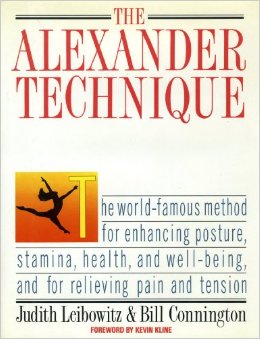 The Alexander Technique by Judith Leibowitz & Bill Connington opens, not with a technical definition or theoretical/philosophical description as many books on the Alexander technique do, instead the authors choose to begin with a relatable list of a variety of imaginary people with stress related ailments asking the reader what they have in common followed by a very straightforward explanation that excess tension and stress are direct results of misuse of the body. They even go so far as to list a number of conditions that can be alleviated by using the Alexander Technique.
 Body Learning by Michael J. Gelb was one of the first texts I read on the Alexander Technique, as it was required reading in the very first group introduction to the AT class I took. Upon re-reading it I see now why my teacher and so many others recommend the book to people with little or no experience with the AT. The book contains all of the core concepts of the Alexander Technique with minimal pontificating on possibilities of the future of mankind and other dense topics that plague many AT books, including ones written to be introductions. Also somewhat important in an introduction to the Alexander technique, which can sometimes be seen as a strange and esoteric practice, is the fact that Michael Gelb carriers some weight as an author from his other books which lends itself to the AT; not to mention the many endorsements by well-known individuals in related fields and a foreword by Walter Carrington.
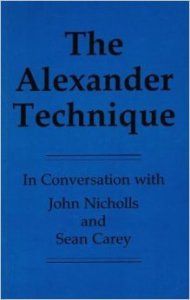 Having had a fair amount of personal experience with John Nicholls in lessons and classes, I had some preconceived ideas about how this book would read. I expected a straight-forward pseudo-medical explanation with scientific research to support the ideas without the “hippie stuff” that comes with many of his generation’s group of teachers. I was surprised that within the first chapter the conversation had already included Buddhist meditation, Gurdjieff, and possibilities for world change as a result of AT work. The subject of morality came up as John Dewey, Dr. Frank Pierce Jones, and Aldous Huxley believed that the technique lead to a form of ethics/morality. John Nicholls inferred that, “[the AT] may help the construction of a personal morality out of one’s own experience;” that the AT helps “to connect with the inner guide.” JN drew connections through many seemingly unrelated areas; he pointed out an interesting parallel to the schooling of horses, noting that the idea of “Self-carriage” or support of the limbs by the back is very similar to the idea of Primary Control. All of the subjects were approached and discussed in very practical ways without making any far reaching claims lacking evidence.
 Connecting Up the Dots