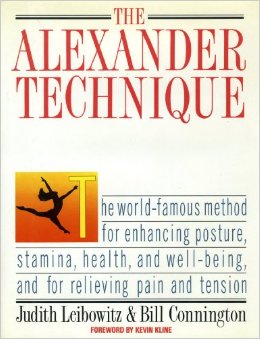
 The Alexander Technique by Judith Leibowitz & Bill Connington opens, not with a technical definition or theoretical/philosophical description as many books on the Alexander technique do, instead the authors choose to begin with a relatable list of a variety of imaginary people with stress related ailments asking the reader what they have in common followed by a very straightforward explanation that excess tension and stress are direct results of misuse of the body. They even go so far as to list a number of conditions that can be alleviated by using the Alexander Technique.
Many modalities preach awareness, however, few directly improve specific awarenesses. The authors assert that Alexander’s technique heightened his awareness on many levels; including (from the Introduction):
- kinesthetic- He became aware of (1) the feelings and tensions in his body and (2) his body in space.
- visual- He saw his habits more clearly.
- structural- He had greater knowledge of his anatomy and movement.
- intellectual- He was more clearly aware of his thinking process.
- emotional- He saw how he interacted and behaved with other people and his environment.
The book has a warm, personal and relatable style, detailing the personal journeys of Judy (who overcame many aspects of Polio) and Bill (who overcame personally learned mal-coordination to hone his skill as an actor). After the authors’ stories the book moves into case studies of many Alexander students which are more akin to personal stories of transformation from students than scientific case studies keeping the tone personal. Along with the theme of personal transformation, there seems to be an interest in childhood development as the later crops up repeatedly throughout the book and it’s importance is stressed; the authors on the subject, “We have to overcome our schooling and conditioning, which was of a goal-oriented or “end-gaining” nature that often leads to a fear of learning and of succeeding.”
Another theme that is recurrent is mindset. The authors assert that mindsets or beliefs create muscular holdings in the body and that leaving one’s self alone is key. They cite Zen in the Art of Archery as an accurate description of the Alexander process and go on to describe the relationship between the principals of the AT; Inhibition, Mental Directions, and Sensory Awareness (in that order). They detail the primary directions and their meaning. Interestingly, the direction, “and let my shoulders widen” is given equal value to the other directions.
The authors make a case for learning basic anatomy stating, “Because the mental directions refer to the anatomical structure, understanding the structure will help understand direction.” The authors make a case against visualization which is interesting as many teachers do not follow this advice, “Unlike some teachers, we do not ask our students to think of their bodies as balloons filled with helium, or to imagine the tension draining out of their bodies like water down a sink drain- in other words, we do not work with what is usually known as visualization.”
In the next chapters on mind-body connection and self-image & psychological factors there are more stories from the authors about how the AT accelerated progress in psychotherapy, relating the experience to the work of Reich. There are also many more stories of personal transformation related to those topics from students keeping with the overall personal and relatable tone of the book.
Some interesting tidbits to put in context of time are the questions, “How much does an AT lesson cost?” and “How often should I take lessons?” The answer to the former is $30-70, which means the cost hasn’t risen all that much since the book was written in 1990. The answer to the later is also interesting as she mentions that Alexander would tell people to come for a “course of lessons” meaning five lessons a week for six weeks. The authors advocates for three lessons a week for two weeks, two lessons for two weeks, then a lesson per week citing financial and time constraint changes in the average person since Alexander’s death. Also interesting is the advice to get a referral from your doctor and send in an insurance claim/reimburse form for your Alexander lessons; I wonder what the success rate for this practice is.
Following this is a section on what happens in lessons which in addition to the overall style and tone of the book make it an excellent introduction to the Alexander technique. The authors note that group classes are more economical but, “You must remember that the hands-on help is the most important part of the lesson.” Also in this section is useful information for student and teacher, “The Alexander teacher never forces a change upon a student but asks the student to think the directions so that messages are sent from the student’s brain through the nervous system to the muscles.”
The second half of the book contains “The Leibowitz Procedures” which Judy developed while teaching actors at Juilliard. While Judy notes that the Leibowitz Procedures and the Alexander Technique are not the same thing, they include many of the movements a teacher would guide a student through in an Alexander lesson. The section opens with instructions on how to observe yourself accompanied by a long list of questions leading to awareness of specific parts. This is then taken into activities including speaking, sitting at the computer, writing, talking on the phone, driving, climbing stairs, lifting heavy objects, vacuuming, carrying bags, sleeping, and gardening.
Following this trend Judy takes the procedures and applies them to sports and exercise activities such as weightlifting, swimming, biking, aerobics, walking, running, golf, tennis, dancing, skiing, riding, horse riding, and yoga. Judy mentioned earlier in the book that one of the purposes of the book was to offer a chance for the many people who don’t have access to an Alexander teacher nearby something to work with on their own. The Liebowitz Procedures are some of the best instructions for self-study that I’ve come across, however there is much less of a chance for success without a teacher’s hands as the authors admit.
The book concludes by stating that the Alexander technique is a tool for living and will help you deal with any life situation, but that you must give yourself plenty of time. As Judy had a hand in training most of the teachers that trained me, I can clearly see her influence in their teaching. It’s interesting to me to note the points where my trainers departed from her methodology as she didn’t have a cookie-cutter process. It’s clear through her writings and her influence on several generations of teachers that her commitment to the principals and skill made her a master teacher of the Alexander technique.
 Body Learning by Michael J. Gelb was one of the first texts I read on the Alexander Technique, as it was required reading in the very first group introduction to the AT class I took. Upon re-reading it I see now why my teacher and so many others recommend the book to people with little or no experience with the AT. The book contains all of the core concepts of the Alexander Technique with minimal pontificating on possibilities of the future of mankind and other dense topics that plague many AT books, including ones written to be introductions. Also somewhat important in an introduction to the Alexander technique, which can sometimes be seen as a strange and esoteric practice, is the fact that Michael Gelb carriers some weight as an author from his other books which lends itself to the AT; not to mention the many endorsements by well-known individuals in related fields and a foreword by Walter Carrington.
 Having had a fair amount of personal experience with John Nicholls in lessons and classes, I had some preconceived ideas about how this book would read. I expected a straight-forward pseudo-medical explanation with scientific research to support the ideas without the “hippie stuff” that comes with many of his generation’s group of teachers. I was surprised that within the first chapter the conversation had already included Buddhist meditation, Gurdjieff, and possibilities for world change as a result of AT work. The subject of morality came up as John Dewey, Dr. Frank Pierce Jones, and Aldous Huxley believed that the technique lead to a form of ethics/morality. John Nicholls inferred that, “[the AT] may help the construction of a personal morality out of one’s own experience;” that the AT helps “to connect with the inner guide.” JN drew connections through many seemingly unrelated areas; he pointed out an interesting parallel to the schooling of horses, noting that the idea of “Self-carriage” or support of the limbs by the back is very similar to the idea of Primary Control. All of the subjects were approached and discussed in very practical ways without making any far reaching claims lacking evidence.
 Connecting Up the Dots